Japan Sendai Mission 日本仙台伝道部
Teruya Jidai ('74-'77) 照屋時代帰還宣教師
RM Site-同窓生サイト
1970s vs. Now 1970年代対現在
Fast Food, Konbini, Mega-stores, Food Carts and (cheaper) Restaurants
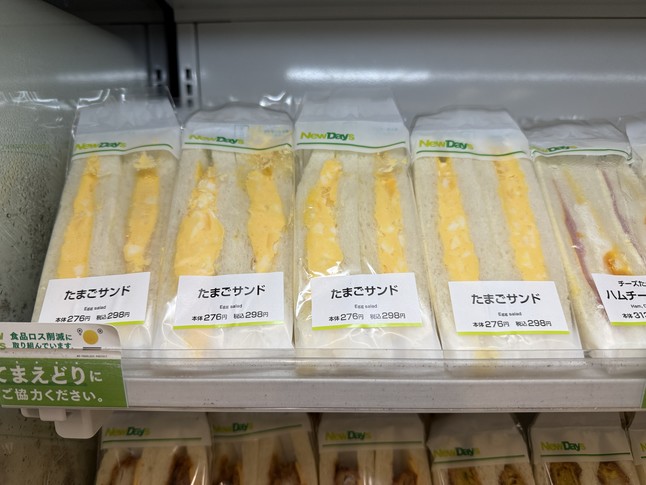 |
| Tamago-sando (egg salad sandwich), a cult-like favorite for Tourists |
As missionaries in Touhoku in the 1970s, Sendai was the only city with any American fast food outlets-one Dairy Queen and one Shakey's Pizza--that's it. Nowadays, there are McDonalds in nearly every mission city. 7-11, now a Japanese-owned company, first moved into Touhoku around 1975, and now seem to be everywhere. Circle K and numerous Japanese-branded convenience stores (konbini) have also sprung up all over--Lawson Station, Daily Store and NewDays (@JR East Ekis) to name a few. The konbini operate very similarly to ones in America, but don't sell gasoline and do sell fresh food, including Nihon-teki stuff like sushi, ika, oden and obentou. Mostly young people work at konbini, so the days of chatting with the obaasan at the disappearing mom-and-pop corner stores are mostly gone. Missionaries and tourists often grab snacks or lunch at konbini.
Nowadays you also see more and more big US-type mega-stores for food, music, home improvements, electronics etc. These superstores have huge parking lots, something unfathomable in the 1970s. Costco has two locations inTouhoku, one each in Yamagata (2015) and Sendai (2016). Even Sweden's Ikea has a store in Sendai (2014).
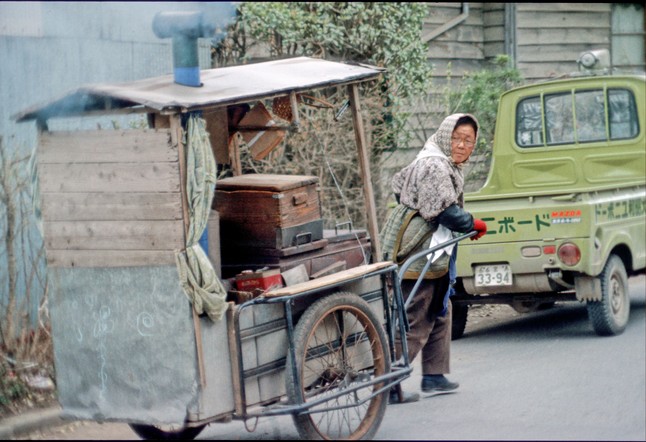 Remember the hand carts plying the streets with fresh vegetables, manjuu (nikuman), and such? Don't see many of those anymore. In winter, hot sweet potato (yakiimo) vendor carts were also plentiful back in "old" Japan. Yakiimo vendors are still occasionally seen, but instead they drive small trucks around with loudspeakers touting their "YAKI--I--MO-----" for sale, like the pied piper or the ice cream man on a hot summer day.
Now plentiful in most larger cities in the mission are kaitenzushi (conveyer belt sushi), donburi, and also all-you-can-eat Korean-bbq style yakiniku restaurants. These are generally nationwide chains and are generally inexpensive enough for missionaries. Ramen specialty shops seem to also be very popular with some missionaries (some are obsessed, it seems).
Trains, Planes and Automobiles
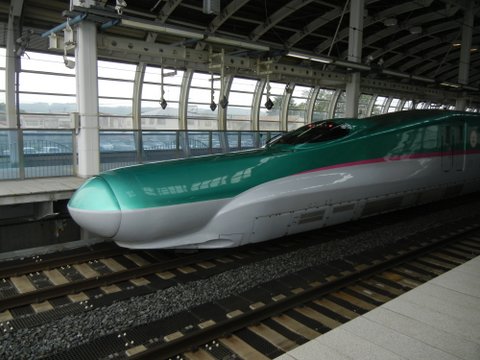
Touhoku Shinkansen. Back in the 1970s a favorite subject of conversation was the construction of the Touhoku Shinkansen ('bullet' train), which locals complained was taking forever to build. After at least 11 years of work in June 1982, the Shinkansen began operating between theTokyo area and Morioka in the middle of Touhoku. Today, Shinkansen can whisk you from Tokyo to Sendai eki (station) in as little as 1 hour 31 minutes at maximum speeds of 320 km/hr (~200 mph) as compared to about four hours time on the fastest (80 mph) trains back in our day,Tokkyuu (limited express). Morioka was the northern Touhoku Shinkansen terminus for over 20 years until December 2002, when the line was completed to Hachinohe. Eight years later, in December 2010, the extension to Shin-Aomori began operations. Trains on the Touhoku Shinkansen are named, from fastest (fewest stops) to slowest (most stops), "Hayabusa," "Yamabiko" and "Nasuno." Hayabusa service made its debut in March 2011 to Shin-Aomori, and features the new E5 model of Shinkansen, green in color and a distinct nose, which has, for the first time in modern Japan, three classes: regular, green car and a new addition, "Gran Class," which is closer to what we would think of as first class (whereas green car is a just a small incremental improvement over regular class).
 |
|
An E5 model Hayabusa Shinkansen at Hachinohe (2011)
|
Some bullet train cars were double-deckered in the 1990s and 2000s, but JR East phased those out by 2021. In the old days all trains headed for Tokyo ended at Ueno station on the northern end of downtown Tokyo, but in 1991, Touhoku Shinkansen service was extended south past Ueno all the way to Tokyo station and beginning in 2015, Joban line conventional trains (Pacific coast (Iwaki) now also travel south past Ueno past Tokyo to Shinagawa station. Here's a Wikipedia article on Shinkansen.
The Seikan Tunnel now joins Aomori and Hokkaidou's southern city of Hakodate, replacing the renraku-sen ferries that once linked those cities back in our day. Here's a Wikipedia's article on the tunnel, and diagram. The tunnel, when opened in 1988, was then the world's longest undersea railway tunnel at 53.85 kilometers. In March 2016, Shinkansen trains began running past Shin-Aomori through the Seikan tunnel to the Hakodate area on Hokkaido, but the 240km route all the way to Sapporo of the Hokkaidou Shinkansen won't be completed until 2038 or later. Until then, travel from Hakodate to Sapporo is still on diesel tokkyuu trains (319km), and takes over 3.5 hours.

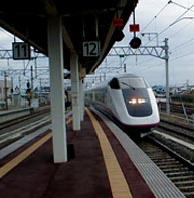 The Yamagata Shinkansen and Akita Shinkansen were completed in 1992 and 1997, using trains called "Tsubasa" and "Komachi," respectively. These bullet trains start in Tokyo, coupled to a Touhoku Shinkansen, then split off at Fukushima and Morioka, respectively, to ride conventional tracks ("zairaisen"), not elevated and at Tokkyuu-level slower speeds (130 km/hr (80 mph) max) for Yamagata (E8 equipment) and Akita (E6 equipment). The Yamagata Shinkansen was extended further north to Shinjou in March 2000. While not as fast as elevated track bullet trains, travel onYamagata/Akita Shinkansen coaches while riding on zairaisen (conventional tracks) is a huge improvement in comfort, but not speed, over Tokkyuu trains.
Another change brought about by the "Shink," especially in cities where the bullet trains arrived in the 1980s, is that large, multistory station buildings, most with integrated department stores, shops and hotels, have replaced the smaller eki of old.
What about Tokkyuu and Kyuukou? Limited express trains (tokkyuu), updated in looks but not in speed, still run the non-bullet routes, such as "Hitachi" or "Tokiwa" on the Jouban-sen (Ueno > Iwaki > Sendai) and "Inaho" or "Tsugaru" along the Japan Sea Coast (Niigata > Tsuruoka > Sakata > Akita > Aomori). Kyuukou (express) trains that were used for inter-city travel by missionaries in the 1970s have virtually disappeared with the arrival of the Shinkansen. As discussed in the Missionary Life section below, depending on the mission leaders, missionary transfers may utilize Shinkansen or intercity highway buses, with renedevous meetings taking place in the city of Sendai.
Subways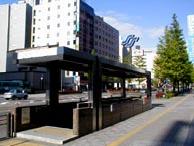 started operating in the city of Sendai in July 1987 when after four years of construction, the Nanboku-sen (South-North line) opened. Nanboku-sen runs from Izumi on the north to just south of Nagamachi. Here's a map. After 11 years of construction, the Touzai-sen (East-West line) opened 06 December 2015. Its western terminus is in front of the Yagiyama Zoo, which is only about 1 km from the (former) Sendai Honbu.

As for automobiles, there are a lot more of them, more parking lots exist to park them, and more highways and high-speed toll roads (kousokudouro) have been built to accomodate them. As mentioned in the Transfers section below, since highways and roads have improved so much since the 1970s, intercity highway buses are common and less expensive than trains, so some missionary transfers in Touhoku are not accomplished by train, but rather by highway bus.
No Smoking?! In the 1970s, train rides meant inhaling copious amounts of second-hand cigarette smoke, especially in winter, when windows were shut tight. I remember grossing myself out after a long, smoky train ride by looking at the soot in my handkerchief after blowing my nose. Oh!!! Luckily, nowadays all JR East trains and ekis are completely non-smoking. Some stations elsewhere in Japan have "smoking corners," most of which are enclosed. In recent years, I've only encountered separate smoking cars on trains in western Japan (JR Central and JR West), where smoking seems to be a little more prevalent.
Narita and Haneda Airports Equally controversial "back then" was the long-delayed construction of the New Tokyo International Airport located over an hour outside of Tokyo in Narita, which finally opened in 1978 with one runway. In the 1970s, we all arrived in and departed from Haneda Airport, which after Narita opened, was primarily used only for domestic flights. Accordingly, for over 30 years, Narita is where missionaries arrived. In 2010, Haneda Airport, which had grown in size and capabilities due to reclaimed land in Tokyo Bay, started allowing more international flights, and effective April 2020, Delta Airlines shifted its operations from Narita to the far more convenient Haneda. Missionaries now arrive at either Tokyo area airport, change planes, then fly to Sendai.
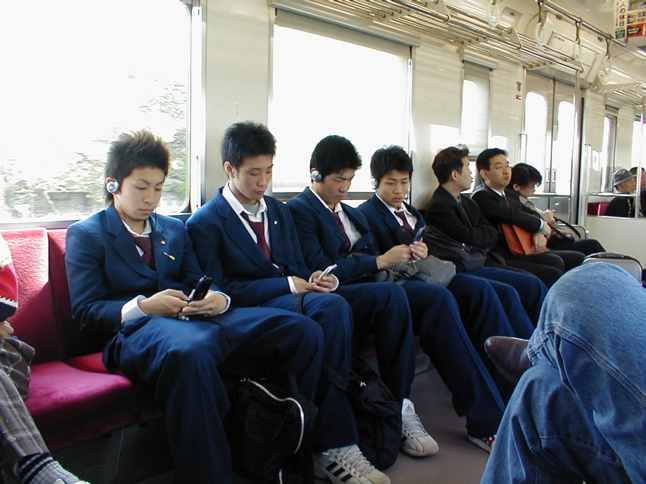 Life with Cell Phones As you can imagine, cell phones ('keitai') and smart phones occupy folks in Japan as much, if not more, than in other countries. As in the US, stores selling mobile phones seem to be everywhere. They don't use the term 'text' or 'texting' in Japan; both email and texting between cell phones is referred to as 'me-ru' (mail). If forced, they say "Internet Mail" and "Keitai Mail" to differentiate. FaceBook is popular in Japan, as are messaging apps such as FaceBook Messenger, WhatsApp and Line. See sections below that discuss missionary use of mobile phones and Internet.
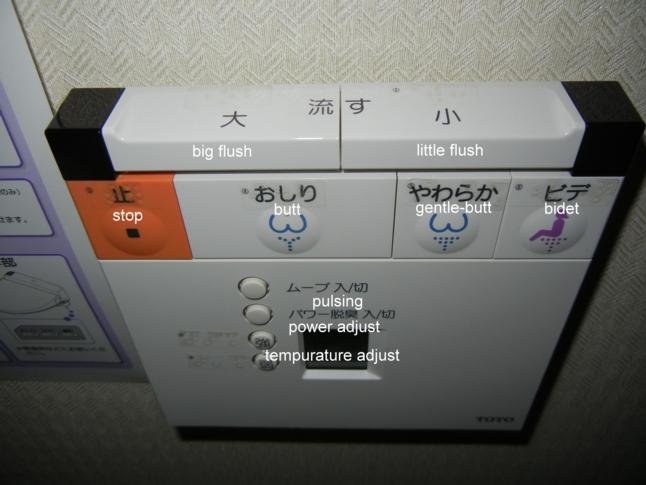 |
| Typical washlet controls, with English captions added |
Toilet Revolution In the 1970s, Japan had mostly squat-type toilets; Western-style 'sitters' were relatively rare. This has changed dramatically in recent years with the improvement of municipal sewer systems and growing popularity of Western-style 'sitters.' In the 1980s, a new toilet seat revolution began when Toto Ltd. introduced the first 'Washlet' toilet seat, which included many advanced features rarely seen outside of Asia, including butt 'oshiri' washing, bidet washing, seat warming, drying and deodorization. Wikipedia's article on Japanese toilets says over 80% of Japanese households now have washlets. Many RMs who have lived in or visited Japan in recent years have become converts to a new standard of clean and dramatic decrease in toilet paper use. Toto also sells its products in the US, and Brondell, a US company, sells a competitive seat they call 'Swash.' (Admin Note: all you need is an electrical outlet near the toilet; I was an early convert and have installed two, one Swash and one Washlet.)
Missionary Life
Apartments In the early days of the mission, nearly all missionaries lived right in the rented building that also served as the church--some were residential homes and some were more industrial-type buildings with living quarters included. The exception to this was sister missionaries, who typically lived in apartments. Sometime in the late 1980s, evidently a decision was made to move all missionaries into apartments separate from church buildings.
Neighborhood Public Baths (FUD)
 |
| Neighborhood bath (sentou) Obaasan (Sakata 1976) |
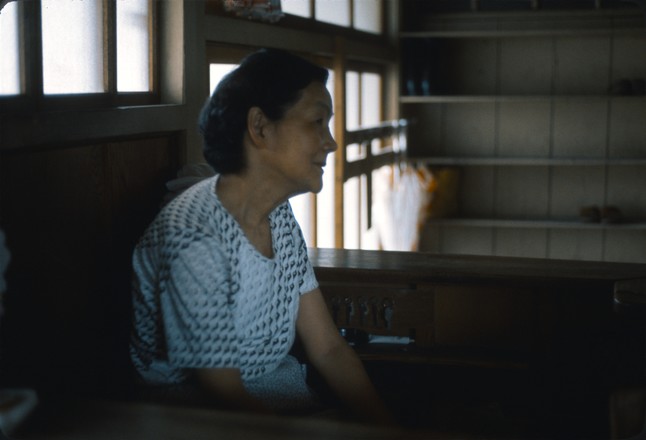
I am sad to report that the honored and revered missionary tradition of the neighborhood public baths, or FUD (sentou) for many years has not been allowed by Sendai mission rules. These were a necessity in the old days when frozen pipes or cold water temperatures limited the effectiveness of our makeshift showers. Many beleive that President Walter Teruya was wise and generous in his allowing us to utilize sentou, even if he was stretching leadership guidelines. If there is one Japanese custom that many missionaries adopted with relish in the old days, this was it. I remember well my first trip to a neighborhood Fud, being escorted there on a frigid December evening in Akita, feeling toasty warm afterwards and sleeping like a baby. Kimochi yokatta!! Sentou can still be found, but have dwindled in numbers as in-home o-furo and plumbing have improved. Onsen, the (mostly) mountain natural hot spring resorts, are as popular as ever. In volcanic Japan, there are thousands of onsen, and some in Touhoku are considered among the best and most traditional in Japan. On a visit to Japan in the early 2000s, it was both interesting and to me, disappointing, to hear perceptions of onsen and sentou in the minds of current gaijin missionaries--they had no real desire to go, even if they could, due to perceptions on the "inappropriate/gross" puritancial end of the scale. Since, in my opinion, Japanese bathing is such an integral part of the culture, I was pleased to hear in recent years that rules against onsen visits were softened a bit; I heard missionaries in a certain jidai could go if taken by a member, and in another jidai, onsen was a part of mission 'culture.' Since every mission president has a certain amount of ability to tweak rules, this particular rule appears to fluctuate, depending on the president and on the Area Presidency directives from the Area office in Tokyo. As of 2019, the Area Presidency directive was no onsen. Zan nen.
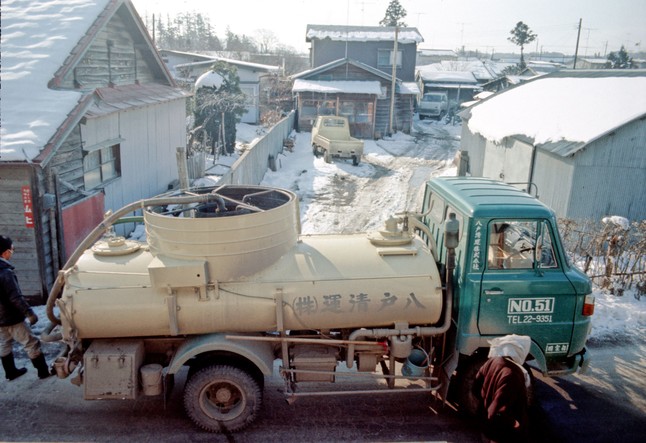
Bennies, Sekiyu Stoves and other conveniences Municipal sewer systems and flush SITTER toilets could only be found at the Sendai Kamisugi building, where about six or eight elders lived in the quarters behind the meeting house, and at some shimai apartments. All other living quarters had squatter toilets that needed to be pumped out by BENNY TRUCKS. Talk about REEKIN'!!!
 |
| A 'benny' truck, poised for pumping at our Hachinohe quarters. |
All missionary apartments now have flush-to-sewer-system toilets, (some of which have washlet seats) and also include electric clothes dryers. I guess the days of clotheslines strung with ghostly wares throughout the missionary living quarters are gone! We used sekiyu (kerosene) stoves to heat our living quarters. Sekiyu stoves are still used in Japan, but most missionary apartments have electric heat and some have air conditioning. In the 1990s and 2000s before missionaries got mobile phones and tablets, district leader apartments had fax machines to receive communications from the honbu.
Updated Scriptures, Terms for Church Units, Leaders and Investigators
Updated Scriptures!? When I attended church in Japan in 1996 for the first time in about 15 years, I thought I heard mistakes during the blessing of the sacrament! Expecting to hear phrases like, "...no mina ni yorite negai tate matsuru," I heard instead more contemporary corresponding wording: "...no mina ni yotte anata ni negai motomemasu." An updated translation of LDS scriptures to more contemporary Japanese language was completed in 1995. Now named Morumon Sho instead of Kei, the updated Book of Mormon and other scripture translations makes the scriptures easier for members and investigators to read and understand. Here's an article that appeared in the LDS Church News on the subject.
Updated Church Unit Terms In conjuction with the Church Leader term changes discussed below, in 2006 church unit terminology was also simplified. Instead of Wa-do-bu and Sutei-ki-bu for Ward and Stake, the "bu" has been dropped, and Stake is now pronounced Suteikku instead of the sirloin-sounding previous term. The term yu-ni tto for "unit" has also been adopted.
| Updated Church Leader Terms | |
| Old (pre-2006) | New (2006 and beyond) |
| dendoubu-chou | dendoubu-kaichou |
| kantoku | bishoppu |
| kantoku-kai | bishoppurikku |
| shibu-chou | shibu-kaichou |
| chihoubu-chou | chihoubu-kaichou |
| shinden-chou | shinden-kaichou |
| fuku-xxx | dai ichi, dai ni-komon |
Updated Church Leader Terminology In September 2006, church leadership terms were changed as listed in the table above. Counselors are no longer Fuku- but -komon, e.g., shibu-kaichoukai dai-ichi komon. When addressing leaders, they use -kaichou, e.g., “Tanaka kaichou.” The same convention is used for Branch, District, Stake, Mission, and Temple presidents. For bishops, “Tanaka bishopu.“ Counselors in a Branch Presidency or Bishopric are referred to as Kyoudai. Counselors in District, Stake, Mission, and Temple Presidencies are now referred to as Kaichou, which corresponds to the English President. The President of the church is still Oaks Daikanchou, but his counselors are now called Eyring Kanchou (daikanchoukai dai-ichi komon) & Christopherson Kanchou (dai-ni komon). My impression after talking to several members in Japan about the updated terminology is that they are generally pleased with the changes. Bishoppu and Bishoppurikku were a little foreign, at first, however.
Updated Term for Investigator In September 2018, then-President Sekiguchi's mission leadership council decided to update missionary use of the term kyudousha for investigator in the mission to shinyuu. 「しんゆう」We understand subsequent to the split of the mission in July 2019, this term was also adopted for use in the Sapporo Mission, where 24 missionaries from Sendai were assimilated. We're unsure about term use in the Sendai Mission that was re-established in July 2024.
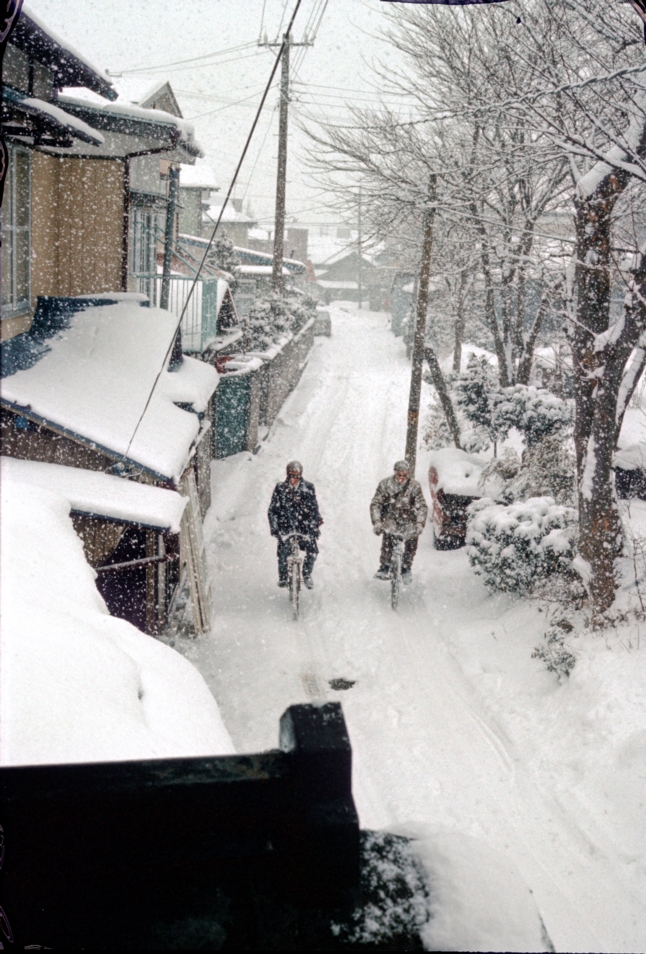
Bicycles Do you remember that we MORAU'D bikes? Yep. During dendou we kept our eyes open for abandoned bikes. After the door approach, one could say we noticed the bike and we would offer to buy it from the owner. "Buy it?," they'd say, "I'll give it to you if you'll take it away!" Of course we spent quite a bit of time repairing and cannibalizing bikes, but that's the way it was done. In 1977, a bike purchase program was established. Nowadays the honbu administers the bike program, including repairs and exchanges, and one of the senior couples assigned there drives a van around the mission to accomplish the delivery and pickup logistics (together with apartment and futon administration, by the way).
In the 1970s we rode our bikes in all weather conditions, which resulted in wet and muddy missionaries showing up for appointments. Nowadays missionaries sport rain gear to keep clean and dry. Current rules, however, allow bike riding only in dry conditions. Accordingly, when it rains or snows, missionaries are mostly relegated to (slowly) trudging through puddles, slush and drifts.
Transfer Methods, Timing and Time Measurement
 Transfer Methods We were reimbursed by the honbu for kyūkō (express) train travel between transfer cities. All transfers were by train. (Except for maybe a certain legendary David Latimer motorcycle trip!) and we were allowed/expected to ride trains alone during transfers. Nowadays Kyuukou (express) trains have virtually disappeared with the arrival of the Shinkansen. For years, since highways and roads have improved so much since the 1970s, most missionary transfers were not by train, but by intercity highway bus, which run more often and are less expensive than Shinkansen.
Update 2025: I learned that most transportation for missionaries is generally now by the most efficient method, regardless of cost, so many transfers are now by Shinkansen. Local trains and intercity buses are used less often, depending on circumstances. These days missionaries are not allowed to travel alone, so each affected companionship usually rides together to Sendai Eki for the rendevous and transfer exhange. The intercity bus terminal is also near the eki.
When meeting with new companions in Sendai for their transfer exchange, missionaries are instructed to NOT congregate in central/busy areas of the Sendai eki, (think bull-kai). Missionaries forward their luggage and belongings the day before the transfer using a 1-day transfer service.
Transfer Timing and Time Measurement In the 1970s we measured the progression of time on our missions using the tried-and-true calendar 'month' system. It seems like we had a new group of missionaries arrive every month, and around the same time, a group of missionaries would go home. Somewhere along the line, the church switched to approximately 6-week transfers, and it appears that missionaries in the Sendai mission and elsewhere worldwide now measure time using transfers. "I've been here for four transfers" would equate to about six months.
Zone Leaders, APs and Trainers For some of the first years of the mission, Zone Leaders didn't have a home, they were junkai missionaries, wandering minstrels that visited the branches in their zone, then returned to Sendai for 3 or 4 days of meetings every month. Extra futons (and for a time before the mission could afford futons, sleeping bags) were kept at each branch for the ZLs for the days they visited. Nowadays ZLs still visit but are stationed at an apartment and have their own investigators.
Nowadays, new missionaries are assigned a Trainer for one or two transfers (6-12 weeks). Missionaries refer to their trainers as their 'dad' or 'father' ('mom' or 'mother' for sisters) and that relationship is pivotal among missionaries. If two elders had the same trainer/father, they often refer to each other as brothers, and their trainer's trainer is referred to as their grandfather (they are his grandchildren.)
Meetinghouses In 1974 when the mission was formed, the only "church-built" meetinghouse was the red brick Sendai Kamisugi building--all other meetinghouses were rented and most were also the residences of missionaries. Since then, the Church has purchased land and built smaller stucco (not much brick) buildings in about two-thirds of the mission cities. A few of the new buildings are two stories. See the Meetinghouse index to look at the church building in your city of interest. Google Maps are linked there. Some "back then" pictures are also included. If you have better pictures of "back then" meetinghouses, please 'Contact Us.'
Honbu In 1974 when the mission was formed, the mission office was housed in the Mukaiyama area of Sendai in a small apartment building, and the mission president resided in a rented house nearby. During President Teruya's three-year assignment, a new mission home was completed in the Yagiyama section of Sendai. Check out honbu pictures in the Meetinghouse section of the Site. If anyone has a picture of Pres. Teruya's old 'house,' please 'Contact Us.' The Sendai mission home built in 1976 is believed to have been sold by the Church during the five years of non-use (when the mission was dissolved). A transitional mission office is currently located in a 10-story office building near the Kamisugi meetinghouse/Sendai Stake center. The mission president and assistants are currently housed in apartments near the Sendai eki.
Conferences (Taikai) It wasn't until after returning home from our missions that many of us learned the all-mission taikai, to which we all looked forward and which Pres. Teruya loved to hold in Sendai, were actually skirting Area Presidency rules. In recent years half-mission meetings have become common, and only on rare occasions, such as at the roll-out of iPads discussed below, are all-mission taikai held. The video conferencing app Zoom was even used in 2019 then Sendai Mission President Sekiguchi to inform all Sendai missionaries at once about the pending dissolution/split of the mission; missionaries watched on their tablets-perhaps this may be the way of the future.
General Conference, something that was a world away when we served, is now streamed at each meetinghouse on the Saturday and Sunday following the actual occurance, taking the place of church meetings that week. English-speakers (including missionaries) can view conference sessions in a separate classroom if they so desire.
Senkyoushigo (Missionaryspeak) See separate Senkyoushigo section were lots of nostalgic laughs can be had. My impression is that senkyoushigo is used sparingly nowadays.
Language Aptitude A larger number of the missionaries currently being called to Japan seem to have studied or know Japanese prior to their missions. Since the language aptitude test that we took when turning in our mission papers was long-ago discontinued, there seems to be more screening to see which potential missionaries have had experience with Japanese in some way. Since very few high schools in Utah offer Japanese classes, Utahns seem to be more rare. In recent years, many more missionaries come from families where a parent or both parents are Japan RMs and from families where one parent is Japanese. In my opinion, many of today's missionaries have languages skills far beyond the 'go' levels of the best of us in the 1970s. Update: On my most recent trips back to Japan, post earthquake disaster (2011), the proficiency of missionaries seems to have actually notched up even higher than when I wrote that last sentence in the early 2000s. I don't have an answer for why (MTC is better? Tools (tablet dictionaries) better? Holy Ghost is better?), but it is amazing.
 Dictionaries, Kanji Study and Cameras The standard dictionary in the old days was Sanseidou's New and Consise Japanese-English Dictionary. It was blue, fit nicely in your shirt or coat pocket, and depending on your LTM (MTC) sensei's recommendation, the Japanese was either hiragana or ro-maji. In the 1990s, missionaries bought relatively inexpensive electronic dictionaries. Since the time tablets arrived in 2015 (see discussion below), missionaries use apps that serve as phrase translators, flash cards, kanji dictionaries, and study tools. As discussed above, in my opinion the proficiency of many gaikokujin missionaries nowadays is several notches above the best of our generation - perhaps these electronic tools have helped contribute to that proficiency.
In the 1990s, certain mission presidents in Japan discouraged or even banned kanji study. (Say what !???!!) Luckily, we were required to study Japanese one hour per day in 1974-76, and most missionaries progressed to the point where kanji study enhanced their Japanese language ability. In 2006, a new MTC Japanese study book called "Learn to Read the Book of Mormon in Japanese" was published. It encourages kanji study and in 2010 I learned it is nicknamed "Sumo" and the smaller vocabulary and phrase book is called "Ninja."
Cameras have changed too, of course, from film/slides to digital. Some missionaries sported camcorders prior to the advent of the ever-improving cameras on smartphones, which are now the standard for photos, which can easily be shared with other missionaries and with family.
Mission Boundary Realignments - Sendai Mission boundaries remained consistent for the 45 years it was in existence (1974-2019), except for a 12-year period (2001-2013), when Niigata prefecture and its five branches (Niigata, Nagaoka, Sanjo, Joetsu, Sado) were part of the mission. Many other Japan mission consolidations, name changes and headquarters changes occurred over the years as charted on the Mission History and Boundaries page. Japan Sendai was re-established as a separate mission on 01 Jul 2024 after five years of being split and merged half each into the Sapporo and Tokyo North missions.
Bizarre (Temporary) Rules: No Konbini and No Raw Items? In late 2006, rules were reportedly set up in all of Asia to prohibit missionaries from entering convenience stores (konbini). Apparently the racy magazines on display were just too racy, but in my opinion missionaries have always had to look the other way when confronted with movie posters etc., that were on the 'chotto are' side. In 2011 I learned that this anti-convenience store rule was lifted (thank goodness!). In recent years, konbini seem like a frequent spot for breaks during dendou, and many mid-day missionary meals are often grabbed there.
Also in 2006, probably in response to the 'Bird Flu' scare in certain (remote) parts of Asia, raw eggs and raw fish were announced to be prohibited for missionaries. This one had me baffled, especially in hygiene-conscious Japan, where sushi and sashimi are proudly ingrained in the culture. Refusing tea from investigators is one thing, but sushi? Luckily, after about only about four months, more broad-minded heads prevailed for Japan on this topic and the rule was lifted.
Mobile Phones Keitai Denwa (Cell/mobile phones) were first distributed to Sendai missionaries, one phone per companionship, at the end of 2008. As a result, all land-line apartment phones were removed. A letter from the Area President announced this new development in the world-wide missionary effort. The letter indicated the purpose of the cell phones is to make missionaries more available at all times to mission presidents, investigators, members etc. Obviously there are restrictions to cell phone use, but everyone seems to agree this is a positive step in missionary work efficiency. I've learned that when transfers take place (described above), there is a hand-off of cell phones. Sometimes the hand-off is botched, so the honbu list of which city's missionaries have which phone is constantly changing. Through 2020, rudimentary flip phones were still being used; but now smartphones are used by missionaries. On my 2024 visit, I learned the senior has a mobile data plan with hotspot capabilities, and the junior companion can login to that hotspot.
Calls Home I don't remember being permitted to call home during the time we were in Japan. I remember international phone calls were extremely expensive in those days, though. For many years (unsure when this started), parents were allowed two conversations over the phone, on Mother's Day and on Christmas. Starting in 2013, Sendai Missionaries were allowed to video chat with home on these two holidays. Most, if not all meetinghouses have Wi-Fi. In recent years, Missionaries have been able to videochat using their own tablets. In 2019, the Church announced more options for missionaries to communicate (as often as weekly) with their families. I understand that this, on average, means around one long videochat per month.
Missionary Makeup and Headcount - More Shimais, Fufu, Native and Non-US/Canadian Missionaries Headcount of missionaries fluctuates more than you might think. When we served in 1974-77, there were an average of about 125 full-time missionaries serving in the Sendai mission, predominantly young men and a small percentage of sister missionaries. Most areas had four missionaries, and many had six. Since then, the percentage of sister missionaries has increased. Native Japanese missionaries now serving have often grown up in the church, some of them children of our native Japanese companions. Senior retired fufu (couple) missionaries, something we never even conceived of back in the 1970s, are now numerous. Mission presidents always seem be seeking Sendai RMs serving as couples, both for honbu/office and fellowshipping/proselyting assignments. In recent years, missionaries from many countries other than the US and Canada are more common, and have included Australia, Philippines, Tahiti, Peru, Portugal, Brazil, Korea, Malaysia, and Singapore. Foreigners living in Japan are also more numerous, so teaching in a language other than Japanese is more common.
According to my (unofficial) observations, the headcount of Sendai missionaries reached a peak of 235 missionaries in 1992, and reached a low of just over 50 missionaries in mid-2011, just after the Daishinsai (Great Earthquake Disaster). After the disaster most mission areas had only two missionaries and many smaller districts were temporarily closed. Missionaries were not permitted in Koriyama and Fukushima due to radiation concerns until 2018, when senior couples were finally allowed to live and serve there. In 2025 I learned all missionaries are now allowed. When the mission reopened in 2024, there were about 70 missionaries. President Ward told me that numbers will continue to grow.
After the 2012 announcement of the lowering of missionary ages to 18 and 19 (for elders and sisters, respectively), Sendai missionary counts rebounded dramatically and surged to a total of 164 missionaries (150 young missionaries and 14 seniors) by 2013 calendar year end. After that bolus of younger missionaries largely returned home, by August 2015 headcount was back down to 85 total missionaries and as a result, some apartments were closed and consolidated. 2025's announcement allowing 18-year old sisters may help increase missionary headcount.
iPads, Tablets, Social Media In 2013 the Church announced more use of the Social Media for missionaries in coming years. In 2015, a rare all-mission taikai was held at the Sendai Kamisugi meetinghouse. Area presidency members taught the missionaries about spiritual preparation and the purpose of the iPad Mini use as a dendou tool. Missionaries were also taught about worthy use and using the Spirit as a filter in addition to the content filters that were reportedly already incorporated on the iPads. Besides assisting with dendou, the Church's bigger purpose apparently is for missionaries to develop good habits using the Internet/technology now, so they have those good habits in place for after their missions to stay safe from the evils that technology can bring. The tablets are also specially configured for auditing by and reporting to Church leadership.
The rollout took several years. In 2017, the last phase of training (online proselyting) was approved. In a post, then President Sekiguchi stated, "To help our missionaries prepare..., [they] review training videos and other online proselyting resources. Missionaries [are] accessing Facebook, Facebook Messenger, and other social media tools... We also encourage...family to support [them] to find people who are interested in the gospel...through social media." 'Line,' a widely-used messaging app in Japan, was also approved for use.
In 2018, iPads in the mission were replaced by Samsung tablets. Each missionary is assigned his or her own tablet to use while serving. Missionaries can receive emails any day of the week (analogous to receiving and reading snail mail), but they are only allowed to reply/send emails on P-day. The tablets are the WiFi-only type, so missionaries have access to Internet-only features primarily when in meetinghouses (which all have Internet WiFi), which, by the way, have the same WiFi password as in the States.
Communication from mission leadership to missionaries is accomplished primarily through the Line App's private group chat. I learned in 2025 that transfer calls are also made this way, with zone leaders holding a sort of zone Zoom call where transfers are announced to everyone in the zone. All missionaries are part of the mission Chat group as well as their zone Chat group. Phone calls, of course, are also made when direct one-on-one communication is necessary.
Calendaring is now on an app mission-wide, and is able to be monitored by the mission office. I learned this in 2024 when visiting the honbu to meet the new mission leaders and office staff. I inquired about meeting some missionaries for lunch in a remote city on a certain day. The staff checked the calendar to let me know those missionaries were tied up with appointments then. Oh.
Suggestions or additions for this section are welcome. Please submit them in a 'Contact Us' entry.